Why sodium races across water
Sodium reacts with water fast enough to melt itself. A small piece floats, balls up into a silvery bead and darts across the surface, pushed by the hydrogen it gives off. Behind all of it sits a single electron that sodium gives up with great ease.
What you see
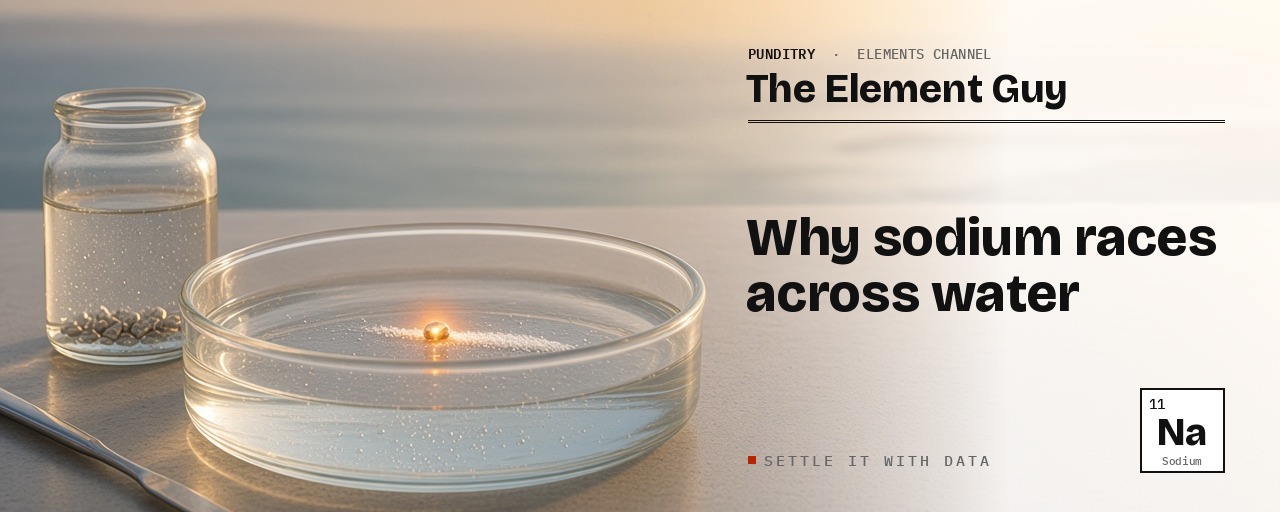
Sodium is a soft, silvery-white metal, and it is lighter than water [1]. Chemistry texts describe a very small piece dropped into a large container of water: it floats, and the reaction gives off enough heat to melt it almost at once into a small silvery ball that moves rapidly across the surface [3]. The ball is pushed along by the hydrogen it gives off. It leaves a white trail of sodium hydroxide, which soon dissolves to give a colourless solution [3]. Nothing of the metal is left: the sodium has become sodium ions in that solution, and the fizz was hydrogen [3][4].
Also in the seriesSodium · 16 Nov 2026
Three numbers place sodium
Eleven electrons, arranged 2, 8, 1, give sodium its row, its column and its charge.
From a fizz to an explosion
Down group 1, water runs from a fizz to an explosion. Lithium gives out the most heat. Caesium is the fastest.
Two lines of yellow
Sodium’s yellow is two lines, 589.0 and 589.6 nanometres. The same pair colours a flame, a streetlight and two dark lines in sunlight.
Why hydrogen has two seats
Hydrogen sits at the top of group 1, yet it is a nonmetal with traits of group 17 as well. The plain chemistry of element 1.
Why helium will not freeze
Helium is the only substance known that stays liquid on cooling at normal pressure, close to absolute zero. The plain chemistry of element 2.