Why sodium races across water
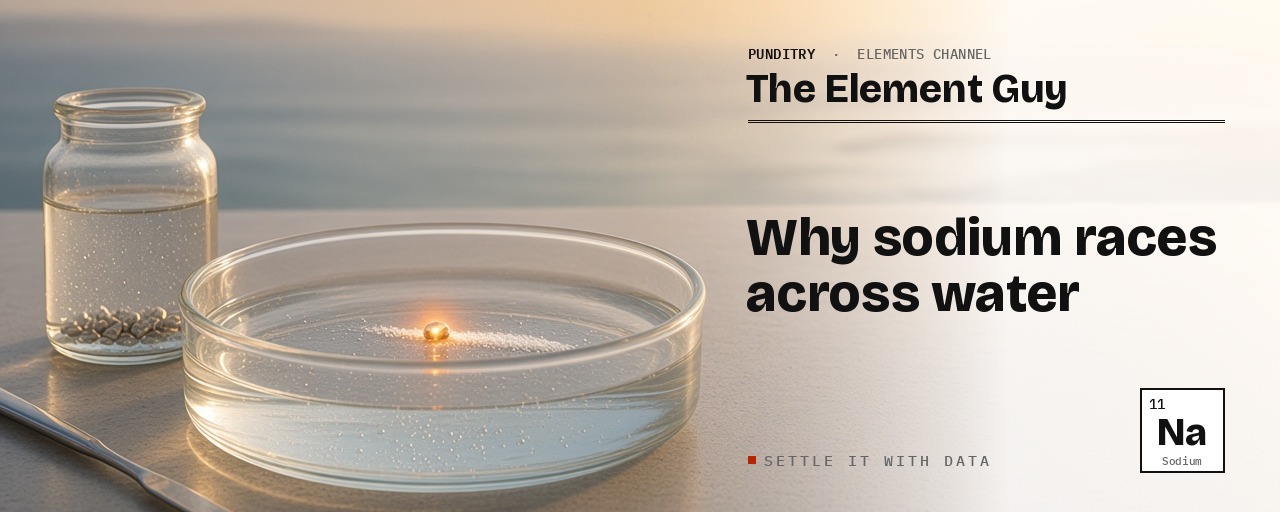
Sodium reacts with water fast enough to melt itself. A small piece floats, balls up into a silvery bead and darts across the surface, pushed by the hydrogen it gives off. Behind all of it sits a single electron that sodium gives up with great ease.
What you see
Sodium is a soft, silvery-white metal, and it is lighter than water [1]. Chemistry texts describe a very small piece dropped into a large container of water: it floats, and the reaction gives off enough heat to melt it almost at once into a small silvery ball that moves rapidly across the surface [3]. The ball is pushed along by the hydrogen it gives off. It leaves a white trail of sodium hydroxide, which soon dissolves to give a colourless solution [3]. Nothing of the metal is left: the sodium has become sodium ions in that solution, and the fizz was hydrogen [3][4].
The equation
Sodium and water give sodium hydroxide (caustic soda) and hydrogen gas [3]:
2Na(s) + 2H₂O(l) → 2NaOH(aq) + H₂(g)
Two sodium, four hydrogen and two oxygen atoms on each side. Written with the ions that are actually in the solution, it reads [4]:
2Na(s) + 2H₂O(l) → 2Na⁺(aq) + 2OH⁻(aq) + H₂(g)
This is a redox reaction, one in which electrons pass from one substance to another. The alkali metals are strong reducing agents: each sodium atom loses an electron and is oxidised, and water gains those electrons and is reduced to hydrogen gas and hydroxide ions [1][4]. As half-equations:
Na(s) → Na⁺(aq) + e⁻
2H₂O(l) + 2e⁻ → H₂(g) + 2OH⁻(aq)
One electron, easily lost
Sodium has 11 electrons, arranged 2, 8, 1: two full inner shells and one electron on its own in a third [1][6]. That lone outer electron is lost with great ease, leaving the sodium ion, Na⁺ [1]. What remains has the same arrangement as neon, the noble gas just before sodium in the periodic table: 2, 8, both shells full [6][9].
The numbers show how loose it is. Removing the outer electron from a sodium atom takes 5.14 electronvolts. Removing a second, from the full shell underneath, takes 47.3 electronvolts, about nine times as much [5][7]. So in its compounds sodium almost always carries a charge of +1 [1].
Where the heat goes
The reaction is exothermic, meaning it gives out heat: an estimated 184 kJ for every mole of sodium, which is about 23 grams of the metal [1][3]. Sodium melts at 97.8 °C [1]. The heat arrives quickly enough to melt the metal almost as soon as it meets the water [3].
Lithium, the metal above sodium in group 1, shows the difference. It also floats and fizzes, but it gives off heat slowly, and its melting point, about 180 °C, is too high for it to melt [2][3].
When the hydrogen catches fire
If the sodium ball becomes trapped against the side of the container, the hydrogen may catch fire [3]. It burns with an orange flame: hydrogen's normally blue flame, coloured by sodium compounds [3]. All the alkali metals react exothermically with water, and the hydrogen they release often burns [4].
Down the group
Every alkali metal reacts with water to give hydrogen and a hydroxide, an alkali, which is how the group got its name [2][3]. The reactions grow more vigorous down the group [3]. Lithium fizzes steadily. Potassium gives off enough heat to light its hydrogen at once, with a lilac flame. Rubidium sinks and reacts violently, and caesium explodes on contact [3].
Heat does not set that order. Lithium gives out the most, an estimated 222 kJ per mole against sodium's 184 [3]. What falls steadily down the group is the energy needed to pull an atom out of the metal and strip its outer electron: about 680 kJ per mole for lithium, 603 for sodium and 455 for caesium [3]. Both parts shrink as the atoms get bigger. The outer electron sits further from the nucleus in each heavier atom, screened from it by extra shells of electrons, and the bonds holding the metal together weaken [3]. The lower that energy, the faster the reaction [3]. Sodium sits second in line: quicker than lithium, gentler than potassium, rubidium and caesium.
Safety as chemistry
International chemical safety data class sodium as a substance that, in contact with water, releases flammable gases which may ignite spontaneously [8]. It reacts violently with water, and also with carbon dioxide, so water and carbon dioxide are not used on sodium fires; the listed agents are special powder and dry sand [8]. The sodium hydroxide the reaction makes is highly corrosive [1]. The metal breaks down quickly in air and moisture, so it is kept dry, under mineral oil [8].
— The Element Guy, Punditry. Settle it with data.
Sources
- Britannica, “Sodium”. https://www.britannica.com/science/sodium (soft silvery-white metal, lighter than water; atomic weight 22.9898; melting point 97.81 °C; electron configuration 2-8-1; single valence electron lost with great ease, giving Na⁺; oxidation state normally +1; sodium hydroxide highly corrosive)
- Britannica, “Alkali metal”. https://www.britannica.com/science/alkali-metal (group 1 members; named because reaction with water forms alkalies; react vigorously, often violently, with water to release hydrogen; lithium melts at 179 or 180.5 °C in different sections)
- LibreTexts (Jim Clark), “Reactions of Group 1 Elements with Water”. https://chem.libretexts.org/Bookshelves/Inorganic_Chemistry/Supplemental_Modules_and_Websites_%28Inorganic_Chemistry%29/Descriptive_Chemistry/Elements_Organized_by_Block/1_s-Block_Elements/Group__1%3A_The_Alkali_Metals/2Reactions_of_the_Group_1_Elements/Reactions_of_Group_1_Elements_with_Water (general equation; behaviour of Li, Na, K, Rb, Cs on water; sodium melts, ball pushed by hydrogen, white trail, orange flame if trapped; enthalpy estimates Li −222, Na −184 kJ/mol; atomisation plus first ionisation energy Li 680, Na 603, Cs 455 kJ/mol; lower activation energy, faster reaction; reactivity rises down the group)
- LibreTexts (Stephen Contakes), “8.3.1: Alkali Metals' Chemical Properties”. https://chem.libretexts.org/Bookshelves/Inorganic_Chemistry/Inorganic_Chemistry_%28LibreTexts%29/08%3A_Chemistry_of_the_Main_Group_Elements/8.03%3A_Group_1_The_Alkali_Metals/8.3.01%3A_Alkali_Metals%27_Chemical_Properties (alkali metals highly reducing; ionic equation 2M(s) + 2H₂O(l) → 2M⁺ + 2OH⁻ + H₂(g); reactions exothermic, often igniting the hydrogen)
- NIST, Handbook of Basic Atomic Spectroscopic Data, “Atomic Data for Sodium”. https://physics.nist.gov/PhysRefData/Handbook/Tables/sodiumtable1.htm (Na I ionisation energy 5.139076 eV, ground state 3s; Na II ionisation energy 47.2864 eV, ground state 1s²2s²2p⁶)
- OpenStax, Chemistry 2e, 6.4 “Electronic Structure of Atoms (Electron Configurations)”. https://openstax.org/books/chemistry-2e/pages/6-4-electronic-structure-of-atoms-electron-configurations (sodium's 11th electron goes into the 3s orbital: 1s²2s²2p⁶3s¹; Na⁺ is 1s²2s²2p⁶)
- OpenStax, Chemistry 2e, 6.5 “Periodic Variations in Element Properties”. https://openstax.org/books/chemistry-2e/pages/6-5-periodic-variations-in-element-properties (sodium's second ionisation energy removes a core electron, a much higher-energy process)
- ILO/WHO International Chemical Safety Card 0717, Sodium. https://chemicalsafety.ilo.org/dyn/icsc/showcard.display?p_card_id=0717&p_lang=en&p_version=2 (GHS: in contact with water releases flammable gases which may ignite spontaneously; reacts violently with water; reacts violently with extinguishing agents such as water and carbon dioxide; fire fighting: special powder, dry sand; decomposes rapidly in air and moisture; kept under mineral oil, dry)
- LibreTexts (Solano Community College), “6.7: Noble Gas Configuration”. https://chem.libretexts.org/Courses/Solano_Community_College/Introductory_Chemistry_at_Solano_College_-_Updated_2023_04_03/06%3A_Electronic_Structure_and_Chemical_Periodicity/6.07%3A_Noble_Gas_Configuration (sodium is the first element of the third period; its first ten electrons have the same configuration as neon; [Ne]3s¹)